Homeschooling

The Cornell Lab of Ornithology

One of many highlights of our recent trip was being able to visit The Cornell Lab of Ornithology in Ithaca, New York. If you’ve been following my blog for awhile, you’ll know I’ve written several times about my younger son’s love of birds. He’s nine-years-old now, and he’s been talking about birds since he was about four. I am pleasantly surprised that his interest has not faded, though he definitely has his own way of navigating this project. We haven’t done a lot  of in depth study about birds. Instead, we’ve drawn them, watched them, identified dozens of them, collected toy birds, made toy birds, and only occasionally read books about them. Though I encourage it and offer whatever I can to foster his love of birds, I haven’t pushed all the ideas I would like to see done. This has been a good decision. It’s truly a child-led project.

We’ve known about the Cornell Lab of Ornithology for awhile now, and I have been wanting to visit it, but I never thought we would be able to see it so soon. Then my eldest son’s interest in music took us to Cleveland, and well, though that’s not extremely close to Ithaca, it was close enough for us. We had to go!

We loved Ithaca, and we loved the Lab. We went twice. On the first visit, we walked the trails in Sapsucker Woods for about an hour, and then we took the behind-the-scenes tour of the lab. The next day, we went back and took a longer walk through the beautiful Sapsucker Woods.

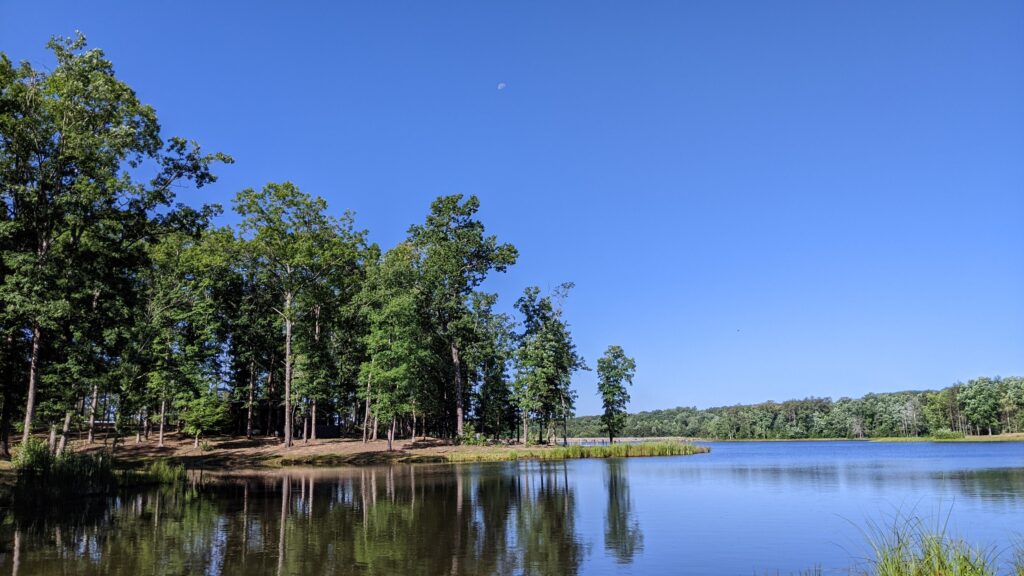
View of the lab from across the pond.

It’s a beautiful building. About 250~300 faculty, students and staff work there. We were told it is mostly member-supported, and Cornell University contributes only a tiny percentage of its budget. It has the beautiful Wall of Birds (click on that link and you won’t be sorry), the Macaulay Library, which you can contribute to, and the Lab also houses Cornell University’s Museum of Vertebrates, so bird specimens aren’t the only resource available to students and researchers.

Here is the Lab’s mission statement:

Our mission is to interpret and conserve the earth’s biological diversity through research, education, and citizen science focused on birds.

If you are at all interested in birds, then you have probably already been to the Cornell Lab of Ornithology’s website. You have probably used the section All About Birdswhich can help you identify the birds you see outside your window. Or you have contributed your sightings to to eBird or another one of their popular citizen science projects.

Their website has much more on it, and if you are a bird lover or you have a child who is, then there’s a lot of educational materials that you can use. I can’t wait until my son gets a little older. I think he’ll really enjoy the Bird Academy. There are also activities and planned lessons for teachers or homeschooling co-op parents in their K-12 Education section. There’s even more than that, but I’ll stop there and let you explore their website yourself. You can also read about the history of the Lab on Wikipedia.

Sapsucker Woods is a special place, and we knew it before we even stepped on a trail. I’ll show you our walks through my photos.

I know Canada Geese are everywhere up north, but we don’t see them too often in Georgia, so we still enjoy encountering them.
Right at the start of the trail, we saw a pileated woodpecker. We see these occasionally in our yard, but it’s always a big deal when they arrive because they don’t come often. We stood there watching this one for quite awhile.
Mama wood duck and her ducklings.

fleabane

Fawn. Mama was there too.
Song sparrow
Haven’t identified this fella yet. Anybody know?

Baby raccoon. There were two siblings and a mom in the tree too.
Georgia Blue Jays have never posed for me like this one did. 😉
The Cornell Lab of Ornithology and Sapsucker Woods is a special place, and I highly recommend that you visit, if you can.

Have you ever been to the Cornell Lab? Please tell me about your visit.

The Cornell Lab of Ornithology Read More »

My experience with the PASS standardized test for homeschoolers

Here’s my son a week after taking the test, super proud of a fish he just caught!

This year my nine-year-old is in the third grade, and according to the law in Georgia, I’m required to have him tested every three years, starting in the 3rd grade. Fortunately, we do not have to show the results to anyone, so it seemed like a good way to assess how he’s doing. But as I started thinking about having to administer the test, and I went over a test prep book with him, I started to realize why teachers in our public schools are frustrated with all the testing going on. This was taking valuable time away from real learning!

And, frankly, I already know where he’s strong and where he’s weak. I am the closest person to him, teaching him all the fundamentals that he would be taught in traditional school. I know what he gets, and I know what he needs more work on, or what we haven’t gone over yet, and the test didn’t tell me anything new. So, it felt like a waste of our time to have to do this, but then again, it’s not a bad idea to occasionally assess how things are going, and unlike the public schools, we only have to do it every three years. I’m grateful for that!

I spent some time trying to research the different test options, and I mostly came up empty. At best, I found brief anecdotes by parents who had used a particular test and liked it or didn’t like it for whatever reason. There were no details about how to order and what testing my child would really look like, so that’s why I’m writing this post.

Because it seemed like the easiest to order and administer, I picked the Personalized Achievement Summary System (PASS test), which is produced by Hewitt Homeschooling. This test is similar to other standardized tests, but it’s made for homeschoolers so that it is easy to administer in their homes. Unfortunately, it’s not approved in every state, but the state of Georgia (and some others) has approved it, and I’m glad because it was easy to order and administer at home.

The first thing I liked about ordering the test, besides the simple online order form, was that I could pick the date I wanted the company to ship the test. So, if you’d like to get the ordering out of the way, but you know you won’t administer the test for another month or two, you can have them ship it a week before you want to use it. You have four weeks to use the test and then return it to Hewitt Homeschooling to have it scored. (You have to do this with every standardized test. You also have to pay for them in case you didn’t know that, which I didn’t know either when I started homeschooling. The PASS test was $36 for one student.)

The test has three sections in reading, language arts and math. When you get the test, you’ll need to carefully read the instructions (but they aren’t complicated) and administer a pre-test to determine what level of test to give to your child. (If you’ve used the test before, you won’t have to do this.) This is because each test booklet (reading, language arts and math) each contains all the levels, and they are numbered from approximately 1-25. (Or something like that — I don’t have the booklets anymore to refer to.) The levels DO NOT equal grade level.

The pre-test is simply 12 questions in each section. It took my son less than an hour to take the pre-test, and then I scored it, and there were instructions to tell me which level to give him for each subject. The instructions also tell you that you can read over the recommended level, and if you think it’s too hard or too easy, you can pick another level that you think is more appropriate for your child. It said a child should be able to answer at least 50%-90% of the questions correctly.

What I also like about the PASS test is that I didn’t have to time my son. He’s never taken a test before, so I really wasn’t sure how he’d feel about sitting there for a long time taking a test. But I took three days to administer the test, giving one section on each day. I let him take a 5-minute break half-way through each test. It took him about an hour to complete each section of the test. (I’m grateful he didn’t have to take all three sections on one day! Three hours would have been a long time.) But he had no problem taking the tests, especially since all it requires is shading in those little bubbles. He kept focused the whole time, and he told me he didn’t think they were too hard.

Once you’re finished, you have to return the bubble sheet with your child’s answers and another form to Hewitt Homeschooling. You need to use a cardboard mailer so that the answer sheet won’t get bent, and you’ll have to pay the postage. You sign a form stating that you will destroy the test booklets because they are under copyright law, and you should not show them to anyone else.

In a few weeks, Hewitt Homeschooling will send you your child’s scores, and not only do they give you your child’s raw score, they’ll give you a percentile of how your child did compared to other homeschoolers who took the same test, and on top of that, they’ll  give you a percentile of how your child did compared to a national standardized test. I have heard that other tests do not give you this much information, so it was helpful to see.

If you’re looking at the PASS test, I hope this was helpful to you. I’m happy to answer any other questions too.

FYI: In the sixth grade, I used the PASS test again, but in the eighth and ninth grades, I used the IOWA assessments purchased through Seton Testing Services. I really liked these tests too, and they were all good preparation for the SAT. If you’d like more information testing for homeschoolers, you can Zoom with me.

My experience with the PASS standardized test for homeschoolers Read More »